
There is an almost invisible moment in the provision of any customer service that ends up being the most important for creating loyalty. It doesn’t happen when the customer receives their receipt, nor when they walk out the door satisfied. It happens much earlier, in the hiring process, onboarding, and the unwavering demands management places on its team.
In the competitive world of currency exchange and money transfers, many companies make decisions based solely on operational speed. They look for employees who type fast, they imagine that being efficient means dispatching people like on an assembly line, and they visualize customers as mere billing tickets. However, what truly defines whether an immigrant will return to that place or recommend it to their family is not in the speed of the keyboard, but in the depth of empathy with which their personal story is received. When that human connection is missing, what often follows is a cold, transactional treatment. Not necessarily because the service provided is incorrect, but because there is no cultural foundation of warmth that gives meaning to the emotions that often accompany the act of sending money or asking for help in a foreign country.
Your Story Isn’t Just Heard; It’s Interpreted with the Heart
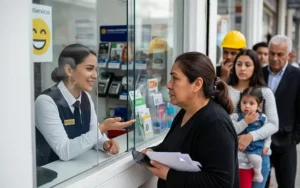
A common mistake is thinking that being behind a teller window consists simply of “charging and giving change.” In reality, it is about understanding the emotional state that already exists in the customer and transforming it with a logic of unconditional support. Every person who enters the branch carries joys or tragedies that are not always obvious at first glance. There are desperate mothers, workers frustrated by traffic, relatives paying for distant hospitals, and widows who don’t know how to navigate paperwork after their husband’s sudden death.
When a teller doesn’t observe this carefully, the service ends up responding with the apathy of a machine, forgetting that there is a human being in front of them. Therefore, before thinking about sales volume, it is worth pausing to consider Kiosko Multiservicios’ golden rule: a smile is part of the uniform and is non-negotiable. What level of stress the customer brings from work, what communication problems arise from a wrong phone top-up, and what vulnerable situations have become normalized but require a pause and active listening. That absolute empathy completely changes the standard of care.
Human Aspects to Nurture from the Teller Window
There are service decisions that, if not instilled from the moment an advisor is hired, resurface as conflicts, complaints, or lost customers. And regaining trust always costs more. Some points worth clearly defining in serving the Latino community are:
-
The relationship between professionalism and humanity; knowing when a customer doesn’t need to be charged, but rather helped to translate a vital phone call in the midst of mourning.
-
The genuine use of patience to listen to why a customer is angry (such as trying to call a dying mother) and resolving the problem, assuming the cost if necessary.
-
The limitations of seeing the user only with dollar signs, prioritizing instead improving their life in any situation.
-
The level of willingness to spend hours explaining a tax return in detail, charging the same as if it took 30 minutes, ensuring the customer understands everything.
The word-of-mouth loyalty of the community is a direct result of feeling respected. These are not minor details. They are the invisible structure of a brand with a soul.
When There Is No Empathy, the Transaction Is Cold and Replaceable
One of the clearest signs of bad service is when the staff member doesn’t care if the customer is crying or made a mistake in the phone number. Instead of moving forward with a direction of hospitable service, the treatment begins to depend on the employee’s mood.
Although this abounds in many giant corporations, it creates a cumulative effect of frustration. Customers feel scolded, doubts are not resolved, and the outcome starts to depend more on the rush to close the register than on a genuine intention to help. This doesn’t happen due to a lack of technological capability, but due to a lack of definition about what it truly means to “be at the service of our people.”
Thinking About the Community Changes Your Business’s Impact
Many choices about whom to hire are made based on a technical resume. But human warmth is not truly experienced on a diploma. It is experienced through the innate ability to smile sincerely, to put oneself in someone else’s shoes, and to offer a glass of water or listen to venting while processing a check.
That is where invaluable factors come into play: how the reputation of a company that has been in the community for over 20 years ages, how staff trained to be “solutions advisors” rather than mere tellers respond, the ease of teaching literacy and how to sign to those who could never go to school, and how the service adapts to technological evolution without losing its human essence. When these variables are not considered, the result may be a profitable business today, but a hollow one tomorrow.
At Kiosko Multiservicios, we like to start by connecting heart to heart, not just scanning IDs. We want to understand how you feel, what you truly need to feel valued, and how our service culture can resolve your day with the utmost respect and an unwavering smile.